Every digital product a business commissions falls into one of two architectural categories, and choosing the wrong one creates months of wasted engineering effort. Web app vs website is not a branding question. It is a systems architecture decision that determines how your platform stores data, processes user actions, and scales under load.
Misclassifying the product you need creates expensive consequences. Founders who commission a static content site when their business requires dynamic user interaction end up rebuilding from scratch within eighteen months. Founders who invest in complex application architecture when a streamlined content platform would serve their goals burn capital on engineering overhead they never needed. This article provides the structural framework for making that decision correctly.
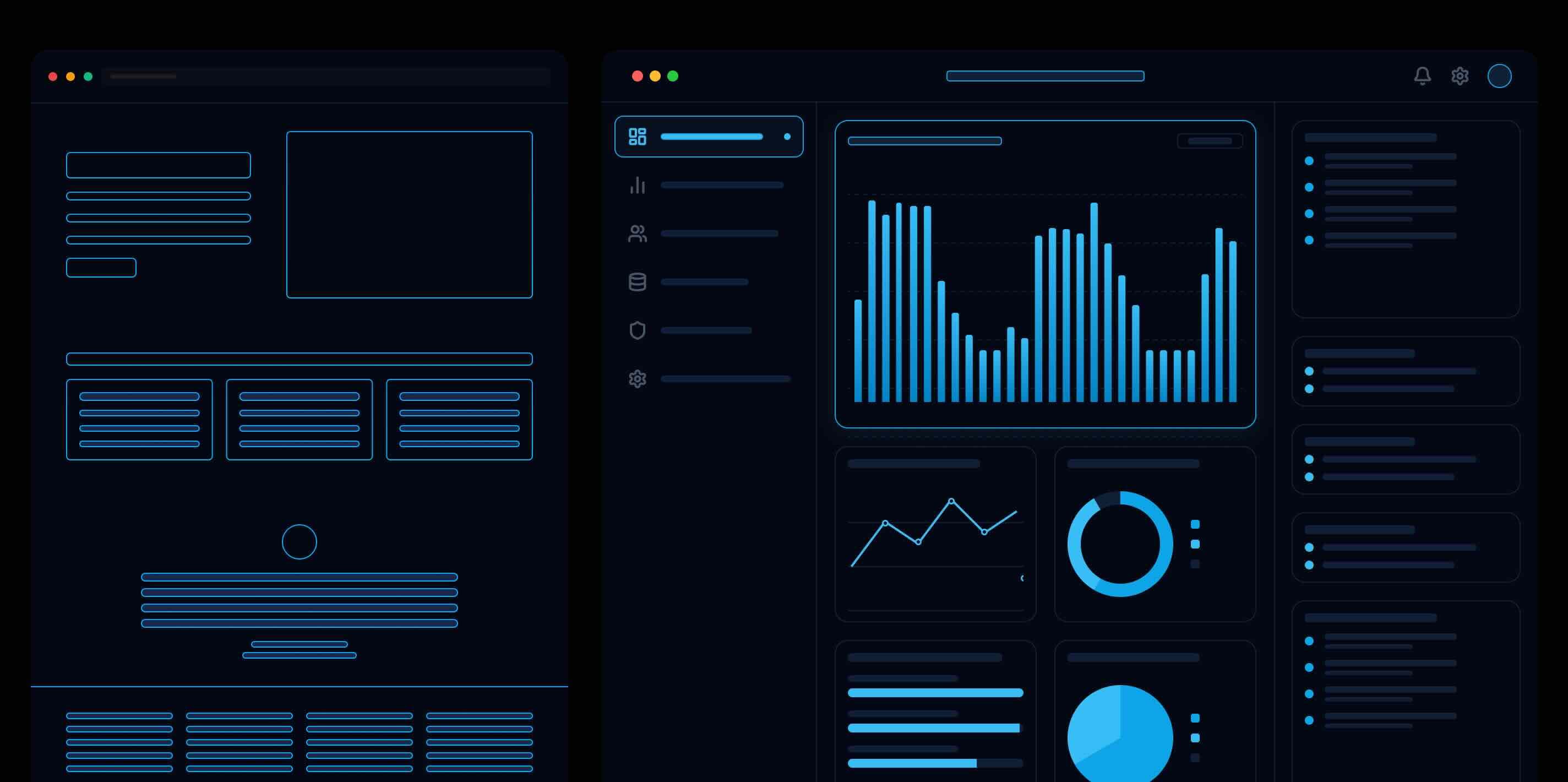
What Is a Website? Static Content Delivered to Passive Viewers
A website is a collection of pre-built pages designed to present information to visitors who consume content without interacting with backend systems. Corporate landing pages, marketing portals, blogs, and product catalogues all fall into this category. The visitor arrives, reads, and leaves. The experience flows in one direction: from the business to the viewer.
From an engineering perspective, a website serves static or server-rendered HTML, CSS, and minimal JavaScript. The content is authored in advance through a CMS or directly in code. Each page loads the same information for every visitor. There are no user accounts, no persistent data state, and no transactional logic running between the browser and a backend database.
Modern websites built on frameworks like Next.js can be statically generated at build time and distributed globally through edge CDN networks. This architecture delivers exceptional page speed, strong SEO performance, and minimal server costs because the infrastructure does not need to process unique logic for each visitor.
What Is a Web Application? Dynamic Systems That Process User Actions
A web application is an interactive software platform that processes unique user inputs, stores persistent data, and returns dynamic responses tailored to each individual session. Online banking dashboards, project management tools, e-commerce checkout flows, booking engines, and SaaS platforms are all web applications.
The defining architectural difference is state management. A web application maintains a continuous relationship between the user's browser and a backend server. Every click, form submission, or data request triggers server-side logic that queries databases, validates permissions, processes business rules, and returns personalized results. The application remembers who the user is, what they have done, and what they are allowed to do next.
Engineering a web application requires authentication systems, database schemas, API layers, role-based access control, real-time data synchronization, and error handling infrastructure. The frontend is not simply displaying content; it is orchestrating a two-way conversation between the user and a complex backend engine.
Web App vs Website: The Five Architectural Differences That Impact Your Budget
Understanding the structural differences between these two product types prevents the most common scoping errors founders make when briefing engineering teams.
User interaction model. A website delivers content that visitors consume passively. A web application processes inputs that users submit actively. If your users need to log in, upload data, complete transactions, or receive personalized responses, you are commissioning an application, not a content platform.
Data persistence and state. A website renders the same content for every visitor from a static data source. A web application maintains unique data states per user session, requiring persistent database infrastructure, session management, and secure data storage. This single distinction can double your backend engineering requirements.
Authentication and authorization. A website typically requires no user identity layer. A web application demands authentication (verifying who the user is) and authorization (controlling what each user can access). Implementing secure identity management adds significant architectural complexity, including password hashing, token validation, session expiry, and multi-factor authentication flows.
Infrastructure and hosting costs. A website can run on a global CDN for minimal monthly cost because it serves pre-built files with no server computation. A web application requires always-on server infrastructure, database hosting, background job processing, and potentially real-time connection management. The operational cost differential between the two models can range from ten to fifty times.
Maintenance and iteration velocity. Updating a website means publishing new content or adjusting visual layouts. Updating a web application means modifying business logic, migrating database schemas, testing user flows across permission levels, and deploying code changes that interact with live user data. The engineering effort required for ongoing maintenance scales dramatically with application complexity.
Relative Engineering Complexity & Budget Breakdown
When Your Business Needs a Website
A content-focused platform is the correct engineering investment when your primary goal is publishing information to attract, educate, or convert an audience. Common scenarios include:
Brand presence and credibility. Your business needs a professional digital presence that communicates positioning, services, and expertise to prospective clients. The visitor journey is linear: arrive, read, contact.
Content marketing and organic search. Your growth strategy depends on publishing articles, case studies, or educational resources that attract search engine traffic. The architecture prioritizes page speed, structured data, and crawlability over interactive functionality.
Product or service catalogues. Your business displays a structured inventory of offerings with detailed descriptions, specifications, and pricing. Visitors browse and compare, but the transaction itself happens through an external channel or a simple contact form.
In these scenarios, investing in application-grade architecture would introduce unnecessary engineering complexity and ongoing maintenance costs without delivering proportional business value.
When Your Business Needs a Web Application
An interactive software platform becomes the correct investment when your digital product must process unique user actions and maintain persistent data relationships. Common scenarios include:
User accounts and personalized dashboards. Your customers need to log in, view account-specific data, manage preferences, or track order history. This requires authentication, database-backed user profiles, and role-based access control.
Transactional workflows. Your platform processes payments, manages bookings, handles inventory allocation, or executes multi-step approval chains. Each transaction involves server-side validation, database writes, and potentially third-party API integrations for payment processing or logistics.
Real-time collaboration or data processing. Your users interact with live data feeds, collaborate on shared documents, or monitor dashboards that update in real time. This demands WebSocket connections, optimistic UI updates, and conflict resolution logic that static content architectures cannot support.
Multi-role access and administrative control. Your platform serves different user types (customers, administrators, partners, support agents) who each require distinct permission levels and interface views. Building and maintaining this authorization architecture is fundamentally different from publishing static pages.
In these scenarios, attempting to stretch a content platform into an interactive tool creates brittle workarounds that collapse under real user load.
Are you confident you are commissioning the right type of digital product?
Share your product vision and core user journey. We will assess whether your requirements align with a content platform, an application, or a hybrid architecture.
The Hybrid Approach: When You Need Both
Many modern businesses require elements of both architectures within a single digital presence. A company might need a high-performance content platform for marketing pages and blog articles, while simultaneously operating a secure customer portal or internal operations dashboard.
Historically, founders facing this hybrid requirement had to choose between two compromised paths: forcing both workloads into a traditional monolithic CMS (where complex backend queries slowed down marketing pages), or splitting their stack into a multi-server decoupled architecture (which doubled hosting bills and introduced network API latency between independent servers).
The modern engineering solution resolves this friction through a headless CMS designed around a unified architecture. Rather than scattering your product across separate infrastructure, modern systems—such as Payload CMS v3 running natively inside the Next.js App Router—unify the content backend, application logic, and presentation layer within a single, cohesive codebase.
This unified approach allows engineering teams to maintain clear logical boundaries without sacrificing infrastructure efficiency. Static marketing pages and blog articles can be pre-rendered at build time and distributed across global edge CDNs for maximum page speed and SEO performance. At the same time, stateful application workflows—such as authenticated user dashboards, custom API endpoints, and database transactions—execute dynamically inside the same Node.js runtime without incurring cross-server HTTP latency.
Founders who leverage this unified architecture avoid the two most common traps in digital product builds: sacrificing marketing performance inside a slow monolith, or burning engineering capital on overcomplicated, multi-server infrastructure.
Frequently Asked Questions

John Hanna
Founder & Principal ArchitectJohn is the founder of BehindPixels and leads its architectural direction and systems strategy. With 22 years of engineering and operational leadership across fintech, pharmaceutical, tourism, retail and B2B operations, he partners with high-growth SaaS platforms and enterprise teams to architect resilient cloud infrastructure, structured API layers, and precision-engineered digital products built for long-term operational scale.