The react native vs native decision is one of the earliest architectural choices that directly shapes a product's budget, maintenance needs, and long-term ability to scale. Choosing the wrong path at this stage does not simply create technical debt. It limits how fast your engineering team can move and determines how much funding gets consumed before your product reaches production-grade stability.
For both business-focused founders and technical leaders, this decision extends beyond basic performance benchmarks. It requires aligning the core functionality of the product with the financial constraints of the business, and understanding exactly where each approach begins to cost more than it saves.
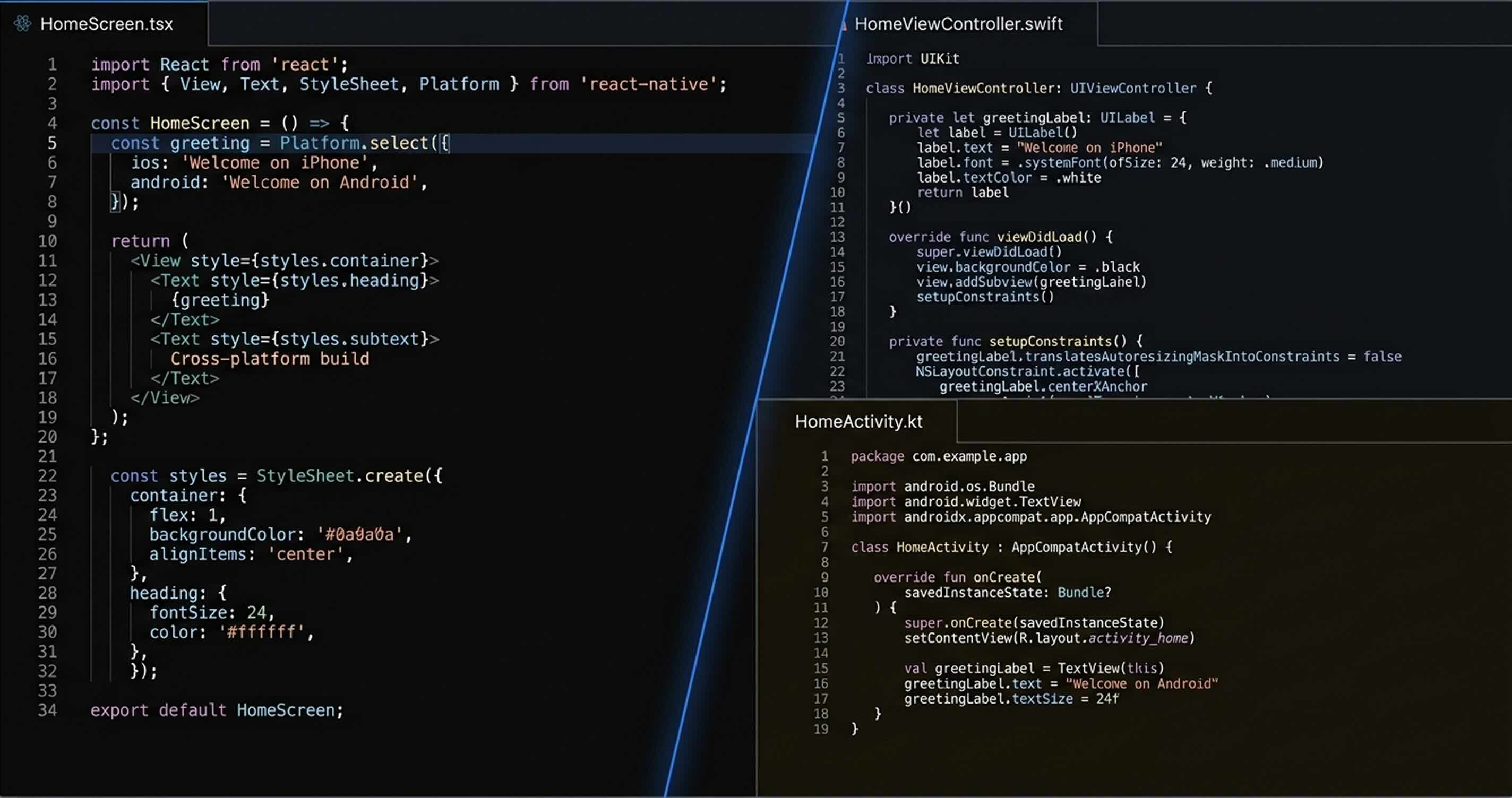
The Cost Equation of React Native vs Native Engineering
The primary reason to choose a cross-platform approach is the reduction in upfront costs and the shorter timeline to launch. React Native consolidates iOS and Android development into a single JavaScript codebase. This eliminates the need to hire and coordinate two separate engineering teams building the exact same features twice.
That consolidation has a clear impact on early cash flow. A single product engineering team managing one repository can build and ship features to both platforms at the same time. This reduces the coordination overhead that typically doubles the testing phase for dual native builds. For founders who need to validate a core business model against a strict funding timeline, that speed is structurally significant. It directly increases the number of release cycles available before the next funding event.
The trade-off is not immediately visible in the initial build. It accumulates over time in the system's dependencies. React Native must use a bridge or shared memory model to access native device hardware, translating JavaScript commands into actions the phone understands. Whenever the product eventually requires complex hardware functions, like biometric security pipelines, background location tracking, or Bluetooth management, engineers must write a custom native module. Each of those modules introduces a piece of code that grows independently of the main JavaScript codebase. This custom code must be updated across both Apple and Google ecosystems as operating systems evolve.
When evaluating the total cost of a cross-platform build for a long-term project, that growing chain of native dependencies is the figure that matters most. Founders building products with deep hardware integration requirements should factor the projected module count into their cost model before committing to an architecture. For a structured assessment of those trade-offs relative to your product's specific requirements, the mobile application engineering evaluation process maps those costs against your transaction volume and release targets.
Cumulative Cost: React Native vs Dual Native
Where Native Architecture Outpaces Cross-Platform Systems
The performance difference between react native vs native Swift and Kotlin is not the same everywhere. It concentrates in specific areas. Understanding which areas apply to your product determines whether that difference actually matters for your business.
Native Swift and Kotlin applications compile directly to machine code. They communicate with the device's interface without an intermediate translation layer. Screen rendering, touch processing, and state updates happen synchronously within the platform's own environment. This gives native builds a structural advantage in three specific scenarios.
Complex interface animation at high frame rates. Custom visuals that require sustained, perfectly smooth output, like trading interfaces with real-time order books, fitness applications with complex motion sequences, or interactive data visualizations, depend on direct access to the device's graphics processor. React Native has narrowed this gap significantly with modern updates, but the overhead of running JavaScript remains. For interfaces where a single dropped frame harms the user experience, native still holds a clear speed advantage.
Biometric and secure hardware integrations. Authentication flows that communicate directly with the secure hardware on an iPhone or Android device require tightly controlled memory and immediate responses. Pushing these operations through React Native's module layer introduces additional steps. This can affect both the perceived speed of the login and the complexity of the error-handling logic behind the scenes.
Background processing with strict resource limits. Operating systems strictly limit what an app can do while running in the background. The window for background tasks, like location tracking or health data syncing, is narrow and non-negotiable. Native Kotlin and Swift give engineers precise control over memory and processing power within those windows. React Native adds a JavaScript layer that competes for those exact same limited resources.
If your product's core utility does not depend on any of these three areas, the performance difference between React Native and native Swift/Kotlin is unlikely to be the deciding factor for your architecture.
Is your mobile architecture aligned with your product goals?
Share your product requirements and target platforms. We will evaluate the engineering and cost trade-offs specific to your use case and map the mobile infrastructure that supports your growth trajectory.
Technical Debt and Long-Term Maintenance
The initial savings of cross-platform engineering must be weighed against the operational costs that accumulate as the system scales. That cost structure shows up in two main ways.
The first is the native module dependency chain described earlier. As the product grows, the number of custom native bridges typically grows with it. Each bridge requires maintenance across two platform ecosystems. When Apple or Google release major operating system updates, they often introduce breaking changes that require immediate engineering attention. A product with twelve custom native modules effectively carries twelve parallel maintenance obligations that exist outside the core JavaScript code.
The second is the specialization required for debugging. When errors occur at the boundary between the JavaScript code and the native environment, the engineering team needs fluency in both the cross-platform framework and the underlying native platform to diagnose them. That deep diagnostic capability is not always present in a JavaScript-first team, and acquiring it through hiring carries its own cost.
Pure native systems built in Swift or Kotlin operate entirely within the stable, first-party frameworks maintained by Apple and Google. Platform updates are predictable and come with official migration guides. For products operating at scale, processing high transaction volumes or operating in regulated environments, that predictability has direct financial value. A native product build eliminates the cross-layer debugging surface entirely, reducing the engineering headcount required to manage platform stability.
Decision Framework: Selecting the Right Mobile Infrastructure
Resolving the react native vs native question requires an honest look at the product's core utility, its hardware requirements, and the financial constraints of the business.
React Native is structurally appropriate when:
- Speed to market is the primary constraint. The product needs to validate a core business model across both platforms before the next funding milestone, and the interface relies on standard data-fetching rather than intensive on-device processing.
- Capital efficiency demands a consolidated team. A single engineering function managing one codebase is operationally leaner than two parallel native teams. The projected hardware requirements are limited enough that the native dependency chain remains manageable.
- The product will migrate selectively over time. Many organizations validate their initial build in React Native and incrementally replace high-performance components with native modules as the product matures. Modern mobile architecture supports this without requiring a full rebuild.
Native Swift/Kotlin is structurally appropriate when:
- The product depends on hardware-intensive tasks. Real-time rendering, secure hardware communication, high-frequency sensor polling, or background processing all benefit from the direct memory control that native environments provide.
- The operational budget supports distinct engineering units. Maintaining separate iOS and Android codebases requires dedicated engineering capacity on each platform. The return on that investment is a simpler, more predictable maintenance model.
- The system operates in a regulated or high-availability environment. Products that require uncompromised processing power, precise memory control, or certified compliance with platform security standards benefit from the structural clarity of a native foundation.
Frequently Asked Questions

Carla Saad
Senior Frontend EngineerCarla is a Senior Frontend Engineer at BehindPixels. She architects component-driven interfaces for platforms operating at scale. Focusing on strict accessibility standards and rendering optimization, she translates complex backend workflows into precise client-side systems.