Every platform reaches a point where slow load times stop being a technical inconvenience and start becoming a measurable revenue problem. Next.js performance optimization sits at this intersection, where frontend architecture decisions directly determine how many users complete a transaction, how much infrastructure capital gets consumed, and how effectively search engines surface your product.
Most teams address performance too late. Features ship, the system grows, and performance becomes something to fix later. By the time the business impact is visible, the structural changes required are expensive. This article covers where performance failures cost real money, which architectural decisions produce measurable improvements, and how to assess whether your current frontend is protecting or eroding your revenue.
Where Slow Interfaces Cost Real Money
Frontend performance failures manifest in three ways that directly affect business outcomes.
1. Conversion rate erosion
Users do not consciously decide to leave a slow platform. They lose momentum. When a product listing takes an extra second to render or a checkout flow stutters between steps, the perceived reliability of the transaction drops. These micro-frictions accumulate across every session.
For commerce-driven platforms, each additional 100 milliseconds of load time correlates with a measurable decrease in completed transactions. The loss is rarely dramatic enough to trigger an alert, which is precisely what makes it dangerous. The revenue leakage is continuous but invisible without proper instrumentation.
2. Infrastructure capital waste
Slow frontends often indicate the server is doing work it should not be doing. When the rendering layer fails to distinguish between content that must load immediately and content that can load later, the system processes everything with equal priority, creating unnecessary compute cycles on every request.
The engineering response to this is usually vertical scaling: more server resources to handle the same traffic. The platform becomes more expensive to operate without serving more users. Capital flows into infrastructure instead of product development.
3. Search visibility decay
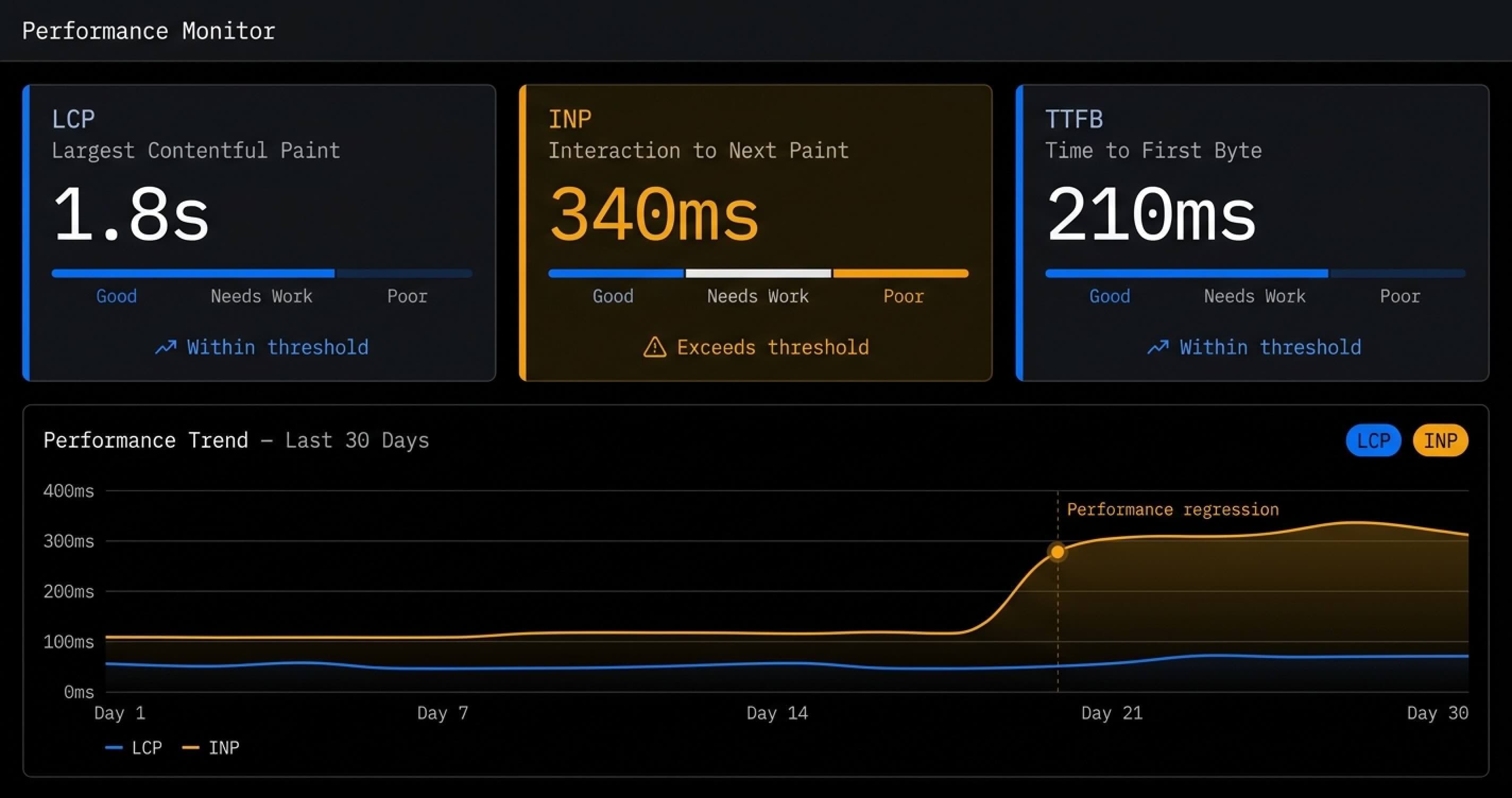
Google uses Core Web Vitals as ranking signals, specifically Largest Contentful Paint (LCP), Interaction to Next Paint (INP), and Cumulative Layout Shift (CLS). A platform with poor real-world performance metrics loses organic search position to faster competitors. For products that depend on organic acquisition, this creates a compounding disadvantage: less visibility, less traffic, less data to optimise against.
The Metrics That Actually Matter for Next.js Performance Optimization
Lighthouse scores measure synthetic conditions: a simulated device on a simulated network. Production performance requires tracking metrics that reflect actual user experience.
Time to First Byte (TTFB) measures elapsed time between the user's request and the server's first response byte. In Next.js architectures, high TTFB typically originates in uncached server-side rendering, slow database queries executed during the render cycle, or missing edge caching. It sets the floor for every other performance metric. No frontend optimisation compensates for a server that takes 800 milliseconds to begin responding.
Largest Contentful Paint (LCP) measures when the largest visible element finishes rendering. A slow LCP means users stare at a partially loaded page, degrading perceived quality regardless of how fast the rest of the interface eventually loads. Platforms engineered for high-performance interface architecture treat LCP as a primary design constraint, not a post-launch audit item.
Interaction to Next Paint (INP) measures the delay between a user interaction and the browser's visual response. In Next.js applications, high INP frequently originates in heavy client-side hydration, where the interface appears loaded but remains unresponsive for several hundred milliseconds. Invisible in development, deeply frustrating in production.
Architectural Strategies for Next.js Performance Optimization
Surface-level optimisation, such as compressing images, minifying bundles, or adding a CDN, addresses symptoms rather than structure. Sustainable Next.js performance optimization requires architectural decisions that reduce the total work the system performs on every request.
Streaming Server-Side Rendering
Traditional SSR blocks the entire response until the server completes all data fetching and renders the full page. Streaming SSR inverts this. The server sends the HTML shell and above-the-fold content immediately, then streams remaining sections as their data resolves.
The user perceives a fast load because meaningful content appears within milliseconds. The server releases the connection incrementally rather than holding it open until the entire page is constructed, reducing memory pressure under concurrent load. The engineering discipline is not in enabling the feature. It is in designing component boundaries that align with data dependency boundaries, so high-priority content never waits for low-priority data.
Selective Hydration and Client Component Boundaries
A common pattern in Next.js applications is marking components as client-rendered whenever they need interactivity. Each client component adds JavaScript the browser must download, parse, and execute before the component becomes responsive.
The architectural improvement is pushing interactivity to the smallest possible boundary. A product listing page does not need client-side JavaScript for the entire layout. Only the cart button, quantity selector, and image carousel require hydration. Everything else remains server-rendered HTML with zero JavaScript cost. This reduces payload size, accelerates INP, and decreases hydration time proportionally.
Edge-First Data Architecture
If the server sits in a single data centre and users span multiple regions, geographic distance becomes the bottleneck. Next.js Middleware and edge-compatible data strategies move rendering and caching closer to the user: static and ISR content cached at the edge, dynamic content served from regional functions rather than routing every request back to a central database.
Rendering strategy and data strategy cannot be designed independently. Both must be planned together to produce a coherent performance profile across all user locations. For platforms operating across multiple regions, this decision belongs in the platform engineering phase, not the optimisation phase.
Is your platform's performance eroding your revenue?
Share your platform's current architecture and growth goals. We will identify where performance debt is introducing risk and map the structural changes required to resolve it.
When Performance Debt Is Actively Eroding Business Outcomes
If three or more of the following describe your platform, the frontend architecture has likely crossed the threshold where performance debt is costing real money:
- Declining conversion rates with stable or growing traffic
- Rising infrastructure costs without proportional user growth
- Lighthouse scores below 70 on mobile
- Real-user LCP above 2.5 seconds
- INP above 200 milliseconds
- Bundle size exceeding 500 KB
- No performance budget in CI/CD: deployments proceed without validating their speed impact
This assessment does not require an engineering audit. Product and business teams can identify these signals from analytics dashboards, infrastructure invoices, and basic performance monitoring tools.
When three or more signals are present, the response requires more than configuration changes. It requires rethinking how the frontend system is architected — from rendering strategy through to the deployment pipeline. The cost of architectural correction scales directly with how long the debt is allowed to compound.
Frequently Asked Questions

Carla Saad
Senior Frontend EngineerCarla is a Senior Frontend Engineer at BehindPixels. She architects component-driven interfaces for platforms operating at scale. Focusing on strict accessibility standards and rendering optimization, she translates complex backend workflows into precise client-side systems.